
Transition to plant-based
Taking steps together toward a more plant-based food supply
From a sustainability perspective, the transition to a greater proportion of plant-based foods is critical. But how do you achieve your organization's goals in a way that keeps everyone on board?
What is the ambition for the share of plant-based food in company restaurants, and how do you achieve that ambition? How do your employees feel about this transition, and at what pace can you take steps to get everyone on board?
Start taking informed steps toward
a more sustainable food supply today.
 Remon Nijnuis
Expert Plant-based Transition
Transition to Plant-based
What we do
Food production contributes 26% of global emissions. Half of those emissions are caused by the production of animal products, while they contribute only 18% to total caloric intake. A transition to more plant-based eating is the solution, but where to start and how to get everyone on board?
PHI Factory will work with your organization to:

Ambition
We establish your ambition for the transition to a more plant-based food offering: what is the envisioned future scenario? We look at the short and long term, and various components such as procurement and sales.
Measurement and analysis
We map out where your organization stands in the protein transition and the unique makeup of different consumer groups. We determine the transition Score and identify key challenges.


Transition plan
We create a detailed transition Plan specifically tailored to your organization's needs and goals. That way, everyone knows where we're going and at what pace we're going.
Communication and behavioral interventions
We develop an effective communication strategy and behavioral interventions to promote the initiated transition. This is how we get everyone on board and ensure a happy customer and a happy provider.

Protein Transition Scan
Discover where you stand in terms of sustainable food.
The Protein Transition Scan provides clear and accessible insight into how your company restaurant is doing in terms of sustainable food. We analyze the current ratio between animal and plant-based products in the offering, calculate the average CO2 emissions per plate, and map out how different consumer groups relate to the protein transition.
After completing the Protein Transition Scan, you will know exactly how your product range scores in terms of animal versus plant-based products, which product groups deliver the most CO2 savings, and how different consumer groups perform.
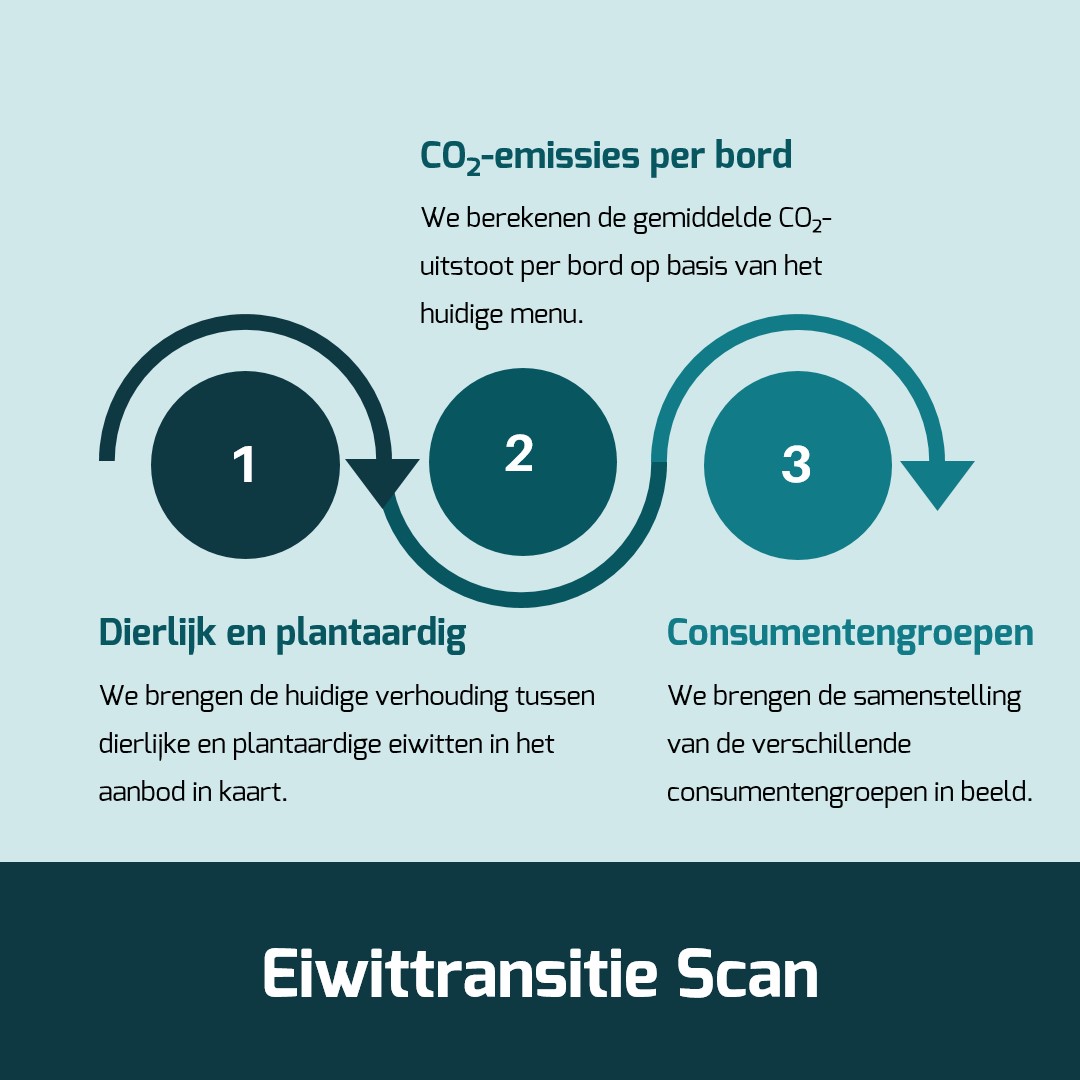
What steps do we take during a Protein Transition Scan?
The Protein Transition Scan provides practical and substantiated insights that can be used immediately to set realistic and ambitious goals. Think of choosing targeted interventions, identifying quick wins, or phasing changes in the product range. In this way, the scan helps develop a future-oriented, healthier, and more sustainable nutrition policy, tailored to the context and possibilities of your organization.
Step 1: Initial estimate of protein ratio using financial data
We collect purchasing, cash register data, and menu cycles to calculate the current ratio of animal versus plant-based protein sources. By using existing data, the scan is easy to perform without extensive data collection.
Step 2: CO2 emissions per plate
Based on standard emission factors, we calculate the average CO2 emissions per plate based on the current menu.
Step 3: Performance of consumer groups
We then show how different consumer groups (e.g., flexitarians, meat eaters, vegetarians) perform.
Step 4: Feedback and any follow-up analysis
You will receive a clear slide deck with the most important findings and appropriate interventions. If desired, the results can serve as a starting point for the in-depth Transition to Plant-Based program.
Frequently asked questions about the Protein Transition Scan
Q: What is the cost of the Protein Transition Scan?
A: Starting at €2,800 euro's.
Q: For which organizations is the Protein Transition Scan suitable?
A: Organizations with a company restaurant or extensive catering facilities.
Q: How long does the Protein Transition Scan take?
A: The total lead time is 4-6 weeks.
Q: What data is required for the scan?
A: Existing purchasing data, cash register data, and/or menu cycles.
More information?
Our experts will happily tell you more.